
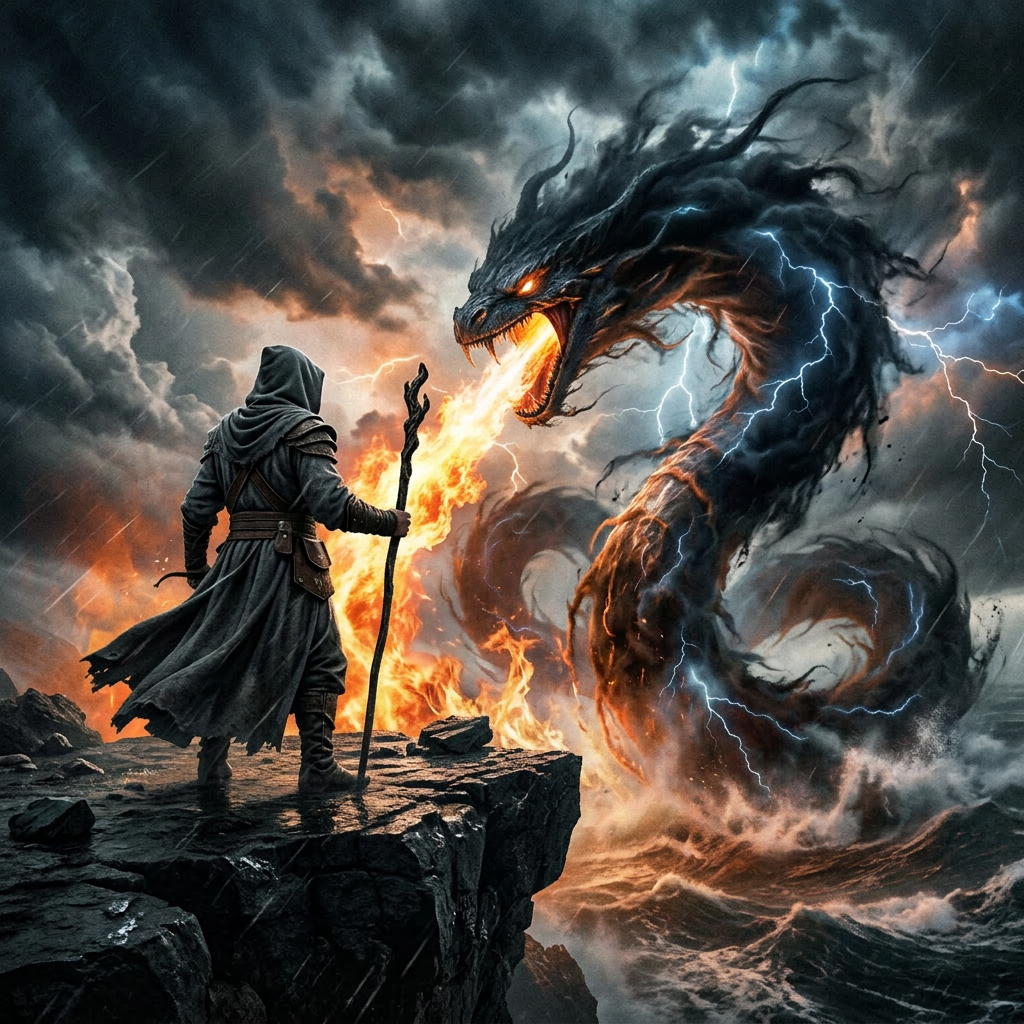

Considered by some to be the devil’s mother, by others as the forebearer of all things wild who claimed birth and death to herself, and yet others as the progenitor of all the gods, Caorthannach (KEER-hawn-nock) is known to the Celts as the Fire Spitter.
An oilliphéist (great sea monster), she haunted swamps and lakes, blocking the paths of travelers. She could summon storms that raged for weeks. Wherever she appeared, the earth turned barren, and the waters were poisoned, leaving wastelands behind.
Part-human and part-serpent, she was a giant, fire-breathing worm hatched in the molten core of the Earth. Her demonic offspring are often compared to the Nephilim, dark forces who tortured humans and spread both pestilence and violence. Their vitriol consumed the minds of rulers and led them astray.
The ancient druids believed Caorthannach originated in Anatolia and arrived in Ireland with the supernatural race known Tuatha Dé Danann. According to the medieval manuscript Lebor Gabála Érenn (The Book of Invasions), the Tuatha Dé Danann lived in Greece and Anatolia before arriving in Ireland.
***
Caorthannach figures into two significant Celtic myths. One involves Fionn mac Cumhaill; the other, St. Patrick.
Fionn mac Cumhaill and the Fianna, his band of warriors, killed a fire-spitting witch who lived in a lake in the north of Ireland. She had burned villages and devoured people. Slaying the witch came with a taboo—never break her thighbone, as it would release a dangerous monster.
A Fianna member named Conan, however, deliberately broke the bone, releasing a small worm. This worm quickly grew into Caorthannach, who began eating the cattle of Ulster. To atone for his recklessness, Conan jumped into the monster’s mouth with a sword and slew it from the inside out. The lake turned red, earning it the name Lough Derg, or “Red Lake,” because her blood turned the lake’s water red.

St. Patrick’s legend is based on the myth that he drove the snakes out of Ireland. Because there never were snakes in Ireland, the term “snakes” was likely a synonym for “demons.”
Standing on the mountain now known as Croagh Patrick, the saint allegedly banished all the serpents and demons into the sea to drown. Caorthannach, however, refused to leave and fled to her lair at Lough Derg.
In an epic battle, the saint pursued Caorthannach on the fastest horse in Ireland. The she-serpent knew Patrick would need water to quench his thirst along the way, so she spit fire, poisoning every well and river she passed.
Although desperately thirsty, Patrick refused to drink from the poisoned wells. At one point, his horse stumbled, and Patrick fell off it. When he knocked his head on the ground, a spring appeared, and Patrick drank the pure water.
He ended up at Hawk’s Rock, a prominent geological outcrop in the Ox Mountains of County Sligo, Ireland, and waited for Caorthannach. She appeared as a fiery dragon. For two days and two nights they struggled. Caorthannach called forth her feared servants, the Sluagh (Sloo-ah), to slay the saint.

The Sluagh are bodiless beings who appear as a gigantic flock of black ravens. Legend has it that they are dead sinners who come back as malicious spirits, taking the souls of all who crossed their path.
Patrick prayed for divine intervention. It came in the form of a great wind that arose like a mighty net and cast Caorthannach and the Sluagh out to sea. In a swell that created Hawk’s Well, the fire-spitter drowned. Today the well is known as the Tullaghan Hill Holy Well, or St. Patrick’s Well, referenced in the works of William Butler Yeats.
In a variation of the story, which sounds a lot like the Fionn mac Cumhaill version, Caorthannach swallowed Patrick, only to have the saint slice her open from the inside. Her blood then turned the waters red.
***
Hawk’s Well, also known as Tullaghan Hill Holy Well and Tobar na Súil, is the setting of a 1916 play by William Butler Yeats. At the Hawk’s Well is the story of an old man who spends his life beside a dry well, waiting for the sudden and brief splash of water that promises immortality.

The well defies logic. Even though it sits atop a mountain more than a mile from the sea, it ebbs and flows in sympathy with ocean tides, which led the 12th-century historian Giraldus Cambrensis to name it one of the Wonders of Ireland.
Scholars also believe the site was used for pre-Christian rituals, likely as a focal point for the veneration of the Celtic goddess Áine (awn-ya), a prominent figure in Irish mythology. Often referred to as the “Queen of the Fairies,” she is associated with the midsummer sun, agriculture, and fertility.
Leave a Reply