

With this month marking the 250th anniversary celebration of America’s founding, I find myself in a nostalgic time warp. With one foot planted in Philadelphia in 1976 and the other in Southwest Florida in 2026, I am immersed in two very different cultures that anchor similar events a half-century apart.
Fifty years ago, as a teacher of American Literature at New Milford (Connecticut) High School, I attended a four-week fellowship program on the Bicentennial at Eastern College (now Eastern University) in St. Davids, Pennsylvania. Located about 13 miles northwest of downtown Philadelphia, the school was about half an hour by train from nearby Wayne to the hub of the bicentennial activities.
I didn’t know when I accepted the fellowship that Eastern was a staunchly Christian college that emphasized faith, reason, and justice. But I was able to set my hippie sensibilities aside for the free room and board, books, supplies, field trips, and credits toward my graduate degree in American Studies at Fairfield (Connecticut) University.
Viewed through the prism of American Exceptionalism, the fellowship was Eastern’s 18th annual American Studies program and the culmination of its yearlong observation of Heritage, Horizons and Festival ’76. The curriculum focused on the philosophies that birthed the Revolution, ranging from the Great Awakening, with its emphasis on the colonies’ role as “a city on a hill,” to the Enlightenment, with its priorities on individual liberty, religious tolerance, and natural rights. Delvin L. Covey, PhD, taught the literature component, and Harold C. Howard, PhD, history.
We studied “Sinners in the Hands of an Angry God,” a sermon written by the American theologian Jonathan Edwards, as well as John Locke and his influence on Thomas Jefferson’s Declaration of Independence. We toured Valley Forge.
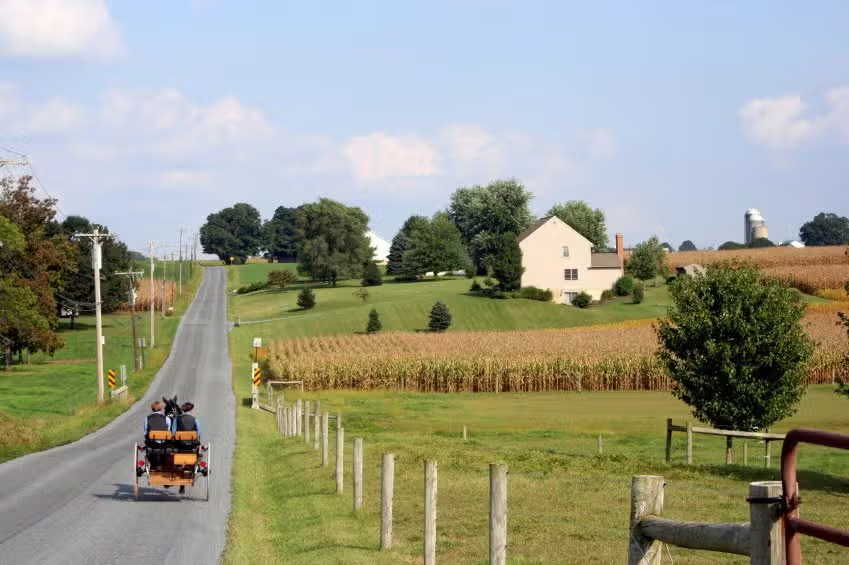
On a day-long field trip led by John L. Ruth, a Mennonite minister, author, and filmmaker who had earned the trust of the Amish, we learned that the Amish and Mennonites settled in Pennsylvania as part of William Penn’s “holy experiment” of religious tolerance. The first sizable group of Amish arrived in Lancaster County in the early 18th century. Our tour culminated with a hearty, family-style dinner at an Amish farmhouse.
But more than all that, we had a day set aside each week specifically to visit the historic landmarks and museums in downtown Philadelphia. Imagine 30 American literature and history teachers on mandatory, self-guided field trips to what has been dubbed the Cradle of History.
Sometimes I went alone; at others, I joined a small group with similar interests. Either way, I got graduate credits to go sightseeing.
For 50 cents a day, I could walk or take a bus that looped around all the historic buildings, including Independence Hall, Franklin Court, and the Liberty Bell Pavilion, which was built specifically for the bicentennial, yet demolished in 2006.
At the northwest end of the Benjamin Franklin Parkway, the bus stopped at the Philadelphia Museum of Art, which featured an exhibit of 300 years of artistic achievements in the Philadelphia area. (The museum’s association with Sylvester Stallone and the 72 “Rocky Steps” would come later that year.) I also visited the Rodin Museum and the Pennsylvania Academy of Fine Arts.
Along the way, I marveled at the hundreds of statues by Alexander Milne Calder, the grandfather; Alexander Stirling Calder, the son; and Alexander Calder, the grandson, best known for his modern art and mobiles.

At night, we’d venture down to the Ben Franklin Parkway, which featured a cultural panorama of stages depicting various phases of Americana. My favorite was a history of dance, from the minuet to the hustle. There were also light shows at Independence Square.
Riding the train home on Friday, July 2, by myself, I became aware of a few tourists singing. They had probably tossed back a few too many bottles of Schmidt’s of Philadelphia (the most popular local beer at the time). Their repertoire included such songs as “This Land is Your Land” and “America the Beautiful.” Before long, everyone joined in. As we pulled into the Wayne station, the entire car was singing “Happy Birthday” to America.
That memory catches my breath—not merely because of the patriotism, but because I don’t think you would see that today. Imbued with the hippie sensibilities and American Exceptionalism that defined me then and now, I wonder what would happen if people dared to belt out those same songs on a train today. Would they be shot? Stabbed? Would I have dared to venture downtown by myself? Buoyed by the prevailing ethos of 1976, I strolled back to the dorm.
Skipping the climactic holiday weekend with its five-hour parade in downtown Philadelphia on the Fourth, I drove up to Connecticut to celebrate with friends. On Sunday, July 4, I headed back to St. Davids, choosing a scenic ride through the mountains of western New Jersey and eastern Pennsylvania. As night fell in the Lehigh Valley, bursting red glares and silvery flares exploded silently in the distance through the dark air. Left, right, and straight ahead, the individual municipalities’ fireworks provided a non-stop, hour-long display that delivered a fitting finale to the nation’s 200th birthday party.

Here’s the time warp again. Come the evening of July 4, 2026, I’ll saunter through my safe Southwest Florida neighborhood—alone or with neighbors—oohing and aahing as displays explode from nearby communities. Straddling the chasm of time and space, I’ll recognize the same person who celebrated American Exceptionalism and rugged individualism in a vastly different milieu a half-century ago.
A hearty Thank You to Chelsea Post, Systems Librarian, Eastern University, for filling in a few blanks.
Leave a Reply